Great Old Ones (3)
[Rebels Against the Elder Gods in August Derleth's Cthulhu Mythos]
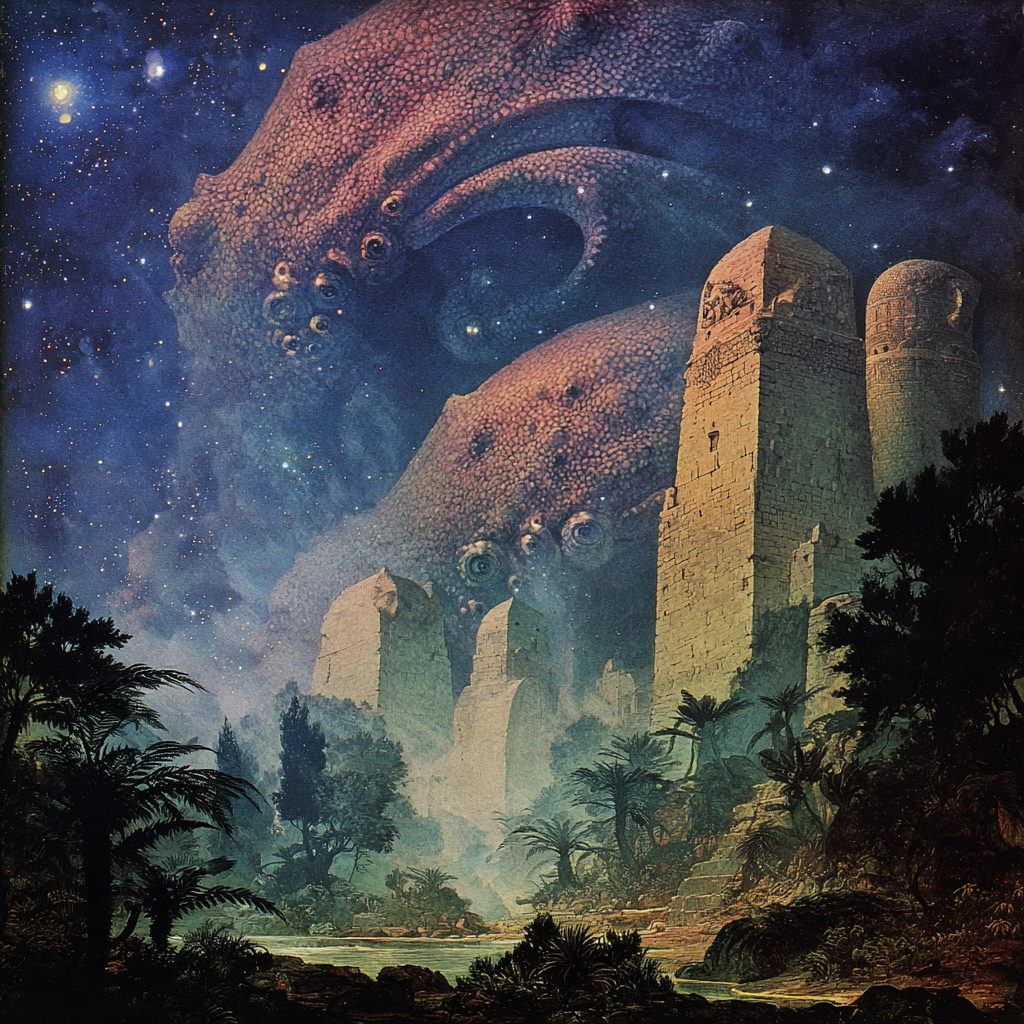 In August Derleth stories, the Great Old Ones (3) are a group of evil alien gods who rebelled against the benign Elder Gods (1).
Derleth referred to the evil gods by several different terms in various stories, and sometimes even within the same story. His names for them included: Great Old Ones (3), Ancient Ones (2), Evil Ones (1), Older Gods, old ones (5). Most of these names can also have different meanings when used in different stories, or even multiple meanings in the same story. For further information, see Elder Gods and Great Old Ones: God Terminology in Derleth's Mythos Stories.
Struggles Against the Elder Gods
Other Meanings of "Great Old Ones"
Gods of Evil
The Great Old Ones (3) are evil beings in conflict with the benevolent Elder Gods (1):
How could I say to him with any conviction at all the things that crowded into my mind as a result of hearing my grandfather’s strange words, the memories that boiled up from deep within—of powerful Ancient Ones [Great Old Ones (3)], elder beings of unbelievable evil, old gods who once inhabited the earth and all the universe as we know it now, and perhaps far more—old gods of ancient good [Elder Gods (1)], and forces of ancient evil [Great Old Ones (3)], of whom the latter were now in leash, and yet ever breaking forth, becoming manifest briefly, horribly, to the world of men. [Beyond2]
. . . a strange mythology traceable to long, long dead aspects of ancient and elder Gods of Good and Evil. [Depths (online text)]
This pattern was part, too, of my uncle’s mythos—the Great Old Ones [Elder Gods (1)] and the Elder Gods, who may, for all I could figure out, have been the same, represented primal good; the Ancient Ones [Great Old Ones (3)], primal evil. [Seal]
Thereupon he launched into a soul-shaking account of incredible, ancient evil, of Great Old Ones. . . [Sky]
. . . the Ancient Ones or the Great Old Ones, who were presumably the motive forces of evil as opposed to those representing good, who were the benevolent Elder Gods. [Island]
. . . and certain others purporting to be mad genii of evil [Great Old Ones (3)] who inhabited outer space before the world was born, and who descended to ravage Earth . . . [OutThere]
. . . the Old or Ancient Ones, the Elder Gods, of cosmic good, and those of cosmic evil, bearing many names, and themselves of different groups . . . [Hastur]
A few narrators seem to suspect a nuance in the Great Old Ones' evil. Perhaps they are not evil in an absolute sense, so much as they are dangerous to mankind:
. . . the Elder Gods, who were beneficent, while the Great Old Ones or Ancient Ones were malign in intent insofar as mankind is concerned. [Gorge] [malignity]
Moreover, these “Great Old Ones” are malevolent . . . [Lurker]
The human/Deep Ones hybrid Marius Phillips questioned the belief that the Great Old Ones (3) are evil in any absolute sense:
. . . for is it not true that if evil triumphs, then evil becomes the law of life, and it is good that must be fought, the rule of the majority establishing the norm, and other than that being abnormal, or, by the way of mankind, the bad, the abhorrent? [Seal (online text)]
But there seems no doubt that the Great Old Ones are a bad influence, from any human point of view. When some of the Cthulhu spawn escaped, they somehow induced humans in the surrounding area to become violent and depraved:
Intelligence was fled, and in its place had been left only evil, vile bestiality. Men and women, killing each other—the scene was too awful to describe. . . And while the papers featured the tragedy at the pier, all of them were filled with smaller, less detailed notes, showing terribly that the evil reign of horror, fore-ordained by the appearance of the creatures from the depths, had begun. All night long, evil had reigned. . . The files of newspapers for those terrifying days are open to anyone who wishes to see. Wherever one’s eye fell on the day’s papers, there were stories of vile and rampant madness. . . Through some sort of telepathy, these creatures from the lake sent slithering into the minds of men the desires which had led to the awful crimes and orgies of the preceding night—which must be going on this night, too. [Depths]
There is a parallel for this in Lovecraft, for he has Old Castro say:
That cult would never die till the stars came right again, and the secret priests would take great Cthulhu from His tomb to revive His subjects and resume His rule of earth. The time would be easy to know, for then mankind would have become as the Great Old Ones; free and wild and beyond good and evil, with laws and morals thrown aside and all men shouting and killing and revelling in joy. Then the liberated Old Ones would teach them new ways to shout and kill and revel and enjoy themselves, and all the earth would flame with a holocaust of ecstasy and freedom. [HPL Call (online text)]
Their Ancientness
The Great Old Ones (3) are incredibly ancient:
. . . a terror-fraught panoply of great, gigantic creatures, in no wise similar to man, as ancient as and quite possibly more ancient than earth itself, or even the solar system so familiar to the astronomers of our time. [Keeper]
Never is it to be thought that man is either oldest or last of the Masters of Earth; nay, nor that the great’r part of life and substance walks alone. The Old Ones [Great Old Ones (3)] were, the Old Ones are, and the Old Ones shall be. [Lurker]
. . . mad genii of evil who inhabited outer space before the world was born . . . [OutThere]
Nevertheless, it appears that the Elder Gods (1) are even older.
Alien Matter and Alien Laws
The Great Old Ones (3) are made of a different sort of stuff than us:
Believe me when I say only that there would appear to be indisputable and damning evidence that this earth, in common with other planets and stars in this and other universes, was at one time inhabited by beings not altogether of flesh and blood, or at least of that flesh and blood we understand, and not entirely of matter as we understand it, beings called the Great Old Ones . . . [Gorge]
They reside outside space as we know it:
Not in the spaces known to us, but between them, They walk calm and primal, of no dimensions, and to us unseen.[Lurker]
Their hands are at the throats of men forever, from beginning of known time to end of time known, yet none sees Them; and Their habitation is even one with your guarded threshold. [Lurker]
Actually, Derleth took the previous two quotes from HPL Dunwich (online text), where they referred only to the Old Ones (2) associated with Yog-Sothoth. In Derleth's mythos, however, it appears that those Old Ones are considered synonymous with the Great Old Ones (3).
Perhaps it is this super-dimensionality that enables the Great Old Ones (3) to transcend time and space:
The Great Old Ones . . . and their supramundane faculties which rendered them insensible to the effects of time and space . . . [Lurker]
“Could there not be some purely scientific principle involved in the time-space travel reputedly the power of the Ancient Ones [Great Old Ones (3)]? That is to say, something related to time as dimension, reducing C. and the others to utterly alien beings subject to other laws, however antipodal to natural laws as we know them?” And again: “What about the possibility of atomic disintegration with subsequent reintegration across time and space? And, if time is to be viewed purely as a dimension, and space as another, the ‘openings’ which are repeatedly mentioned must be fissures in those dimensions. What else?”[Gorge]
Children of the Elder Gods
It appears that the Great Old Ones (3), and the lesser races that serve them, are all in some sense children or descendants of the Elder Gods (1):
“Concern’g ye Old Ones [Great Old Ones (3)], ’tis writ, they wait ev’r at ye Gate, & ye Gate is all places at all times, for They know noth’g of time or place but are in all time & in all place togeth’r without appear’g to be, & there are those amongst Them which can assume divers Shapes & Featurs & any Giv’n Shape & any giv’n Face & ye Gates are for Them ev’rywhere, but ye 1st. was that which I caus’d to be op’d, Namely, in Irem, ye City of Pillars, ye city under ye desert, but wher’r men sett up ye Stones and sayeth thrice ye forbidd’n Words, they shall cause there a Gate to be establish’d & shall wait upon Them Who Come through ye gate, ev’n as Dhols, & ye Abomin. Mi-Go [Outer Ones], & ye Tcho-Tcho peop., & ye Deep Ones, & ye Gugs, & ye Gaunts of ye Night & ye Shoggoths, & ye Voormis, & ye Shantaks which guard Kadath in ye Colde Waste & ye Plateau Leng. All are alike ye Children of ye Elder Gods . . . [Lurker][Whippoorwills]
Ubbo-Sathla is Their Source
According to Derleth's quotes from the Necronomicon, the being Ubbo-Sathla is the progenitor of the Great Old Ones (3):
Ubbo-Sathla is the source, the unbegotten beginning from whom came those who dared set themselves against the Elder Gods who ruled from Betelgeuse, those who warred upon the Elder Gods, the Great Old Ones . . . [Curwen]
Ubbo-Sathla is that unforgotten source whence came those daring to oppose the Elder Gods who ruled from Betelgeuse, the Great Old Ones who fought against the Elder Gods . . . [Lurker]
These quotes seem to partially echo one of Clark Ashton Smith's quotes from the Book of Eibon:
. . . For Ubbo-Sathla is the source and the end. Before the coming of Zhothaqquah [Tsathoggua] or Yok-Zothoth [Yog-Sothoth] or Kthulhut [Cthulhu] from the stars, Ubbo-Sathla dwelt in the steaming fens of the new-made Earth: a mass without head or members, spawning the grey, formless efts of the prime and the grisly prototypes of terrene life . . . And all earthly life, it is told, shall go back at last through the great circle of time to Ubbo-Sathla. [CAS Ubbo (online text)]
Smith makes Ubbo-Sathla the source of life on Earth, but Derleth goes beyond that to make Ubbo-Sathla the source of the alien Great Old Ones (3) as well.
It is not clear how this information squares with Derleth's previous indication that the Great Old Ones are all "children" of the Elder Gods. One interpretation would be that the Elder Gods (1) gave rise to Ubbo-Sathla, who in turn spawned the Great Old Ones (3). However, this interpretation doesn't work well if Ubbo-Sathla was "unbegotten," as stated in the first version of Derleth's Necronomicon quote in Curwen. Perhaps this explains why Derleth changed the word from "unbegotten" to "unforgotten" when he adapted the quote for reuse in Lurker.
Named and Unnameable
Unlike most of the Elder Gods (1), the Great Old Ones (3) are known to have specific names:
. . . in many cultures, the Elder Gods were not often named; the Ancient Ones were, and often, for they were still worshipped and served by followers throughout earth and among the planetary spaces . . . [Seal]
Now, these Great Old Ones, as I have said, have been given various names. [Lurker]
Among the Great Old Ones (3), Hastur alone seems to have some kind of taboo attached to his name; he is frequently referred to as Hastur the Unspeakable, or He Who Is Not To Be Named. Paradoxically, he is often referred to by name, as "Hastur." It is unclear whether he has some other, true name that is more dangerous, or whether the name "Hastur" itself is dangerous.
Great Old Ones List
Derleth never gives an exhaustive list of the Great Old Ones (3), but he often gives partial lists. Based on these, we can infer that the Great Old Ones (3) include at least the following: Atlach-Nacha, Azathoth, Chaugnar Faugn, Cthugha, Cthulhu, Dagon, Hastur, Ithaqua, Lloigor, Nyarlathotep, Rhan-Tegoth, Shub-Niggurath, Tsathoggua, ’Umr At-Tawil, Wendigo, Yig, Yog-Sothoth, and Zhar.
And their terrible names came back now, if before this hour my clue to remembrance had not been made strong enough, had been refused in the fastnesses of my inherent prejudices—Cthulhu, potent leader of the forces of the waters of earth; Yog-Sothoth and Tsathoggua, dwellers in the depths of earth; Lloigor, Hastur, and Ithaqua, the Snow-Thing, and Wind-Walker [Wendigo], who were the elementals of air. [Beyond2]
. . . oblique mention of such beings as Nyarlathotep, Hastur, Lloigor, Cthugha, Azathoth, which, in addition to Cthulhu, had their own bodies of worshippers . . . [Curwen]
Great Old Ones, led by Azathoth and Yog-Sothoth, and numbering among them the primal spawn of the amphibious Cthulhu, the bat-like followers of Hastur the Unspeakable, of Lloigor, Zhar, and Ithaqua, who walked the winds and interstellar space, the earth beings, Nyarlathotep and Shub-Niggurath—the evil beings who sought always to triumph once more over the Elder Gods, who had shut them out or imprisoned them—as Cthulhu long ago slept in the ocean realm of R’lyeh, as Hastur was imprisoned upon a black star near Aldebaran in the Hyades. [Dweller]
. . . the Great Old Ones—the idiot god, Azathoth, that amorphous blight of nethermost confusion which blasphemes and bubbles at the center of all infinity; Yog-Sothoth, the all-in-one and one-in-all, subject to neither the laws of time nor of space, co-existent with all time and coterminous with space; Nyarlathotep, the messenger of the Ancient Ones [Great Old Ones (3)]; Great Cthulhu, waiting to rise again from hidden R’lyeh in the depths of the sea; the unspeakable Hastur, Lord of the Interstellar Spaces; Shub-Niggurath, the black goat of the woods with a thousand young . . . [Gable]
Among my Uncle Amos’s [Amos Tuttle's] papers there are many fearsome names written in his crabbed script: Great Cthulhu, the Lake of Hali, Tsathoggua, Yog-Sothoth, Nyarlathotep, Azathoth, Hastur the Unspeakable, Yuggoth, Aldones, Thale, Aldebaran, the Hyades, Carcosa, and others . . . [Hastur]
. . . the Ancient Ones [Great Old Ones (3)]—who were Cthulhu, master of the waters; Hastur, who roamed the interplanetary spaces before his imprisonment in the dark Lake of Hali; Yog-Sothoth, most powerful of the ancient Ones; Ithaqua, the god of the winds; Tsathoggua and Shub-Niggurath, gods of the earth and of fecundity; Nyarlathotep, their dread messenger; and others . . . [Hastur]
There were yet more names reaching out from these pages to transfix with primal fear—Ubbo-Sathla, Azathoth, the blind idiot god, ’Umr At-Tawil, Tsathoggua, Cthugha, and yet others, all suggestive of a weird and horrible godhead, of a terror-fraught panoply of great, gigantic creatures, in no wise similar to man . . . [Keeper]
. . . the Ancient Ones [Great Old Ones (3)] . . . great Cthulhu, waiting in sleep within some fastness which might be the sunken sea kingdom of R’lyeh; Hastur the Unspeakable, come from the lake of Hali in the Hyades; Nyarlathotep, the fearful messenger of the Ancient Ones [Great Old Ones (3)]; Shub-Niggurath, the Goat With a Thousand Young, symbol of fertility; Ithaqua, ruler of the air, akin to the fabled Wendigo; Yog-Sothoth, the All-in-One and One-in-All, not subject to strictures of time of space, who was greater than all the other Ancient Ones [Great Old Ones (3)] . . . [Keeper]
. . . those who had set up opposition to the Elder Ones [Elder Gods (1)]—the evil followers of Cthulhu, Hastur the Unspeakable, Lloigor and Zhar, the twin Obscenities, and others. [Lair]
“It is written below that tonight is the time when the buried ones wish to come forth, and it is decreed that the servants of E-poh must go beyond Alaozar, beyond the Lake of Dread to the Plateau of Sung, there to await the coming of the Old Ones [Lloigor and Zhar] from below.” [Lair]
The first among them is Cthulhu, who lies supposedly ‘dead but dreaming’ in the unknown sunken city of R’lyeh, which some writers have thought to be in Atlantis, some in Mu, and some few in the sea not far off the coast of Massachusetts. Second among them is Hastur, sometimes called Him Who Is Not To Be Named and Hastur the Unspeakable, who supposedly resides in Hali in the Hyades. Third is Shub-Niggurath, a horrible travesty on a god or goddess of fertility. Next comes one who is described as the ‘Messenger of the Gods’—Nyarlathotep—and particularly of the most powerful extension of the Great Old Ones, the noxious Yog-Sothoth, who shares the dominion of Azathoth, the blind and idiot chaos at the center of infinity. [Lurker]
. . . I found strange names and familiar ones, awful descriptions and mere hints of terror unimaginable in accounts of Yig, the terrible snake-god, of Atlach-Nacha of the spider-shape, of Gnoph-Hek, the “hairy thing” otherwise known as Rhan-Tegoth, of Chaugnar Faugn, the vampiric “feeder,” of the hell-hounds of Tindalos, which prowl the angles of time, and again and again of the monstrous Yog-Sothoth, the “All-in-One and One-in-All,” whose deceptive disguise is as a congeries of iridescent globes concealing the primal horror beneath. [Lurker]
Ancient Ones [Great Old Ones (3)]—who were Great Cthulhu, the water-dweller; Hastur, who reposed at the Lake of Hali in the Hyades; Yog-Sothoth, the All-in-One and One-in-All; Ithaqua, the Wind-Walker; Lloigor, the Star-Treader; Cthugha, who abides in fire; great Azathoth . . . [Seal]
Azathoth, Yog-Sothoth, the amphibious Cthulhu, the bat-like Hastur the Unspeakable, Lloigor, Zhar, Ithaqua, the wind-walker [Wendigo], and the earth beings, Nyarlathotep and Shub-Niggurath . . . [Valley]
Cthulhu, Yog-Sothoth, Hastur, Nyarlathotep, Shub-Niggurath, and many more . . . [Whippoorwills]
Cthulhu and Hastur, Shub-Niggurath and Azathoth, Dagon and Ithaqua and Wendigo and Cthugha . . . [Witches]
Place of Origin
The Great Old Ones (3) originated from distant stars:
Yet I could not help wondering, looking up at them, whether indeed there lay in those star-spaces the colossal beings of the mythology about which my employer had spoken—the Elder Gods, the Ancient Ones [Great Old Ones (3)] . . . [Keeper]
Like the Elder Gods (1), the Great Old Ones (3) may have originated from stars in Rigel and Betelgeuse in the constellation Orion; at the very least, Lloigor and Zhar seem to have originated there:
“Because long before the time of man, strange beings from the stars—from Rigel, Betelgeuse—the stars in Orion, lived here. And some of them—live here yet! . . . Lloigor and Zhar, ancient evil ones, and their minions await the day when they can once more sweep over the earth to bring death and destruction and incredible age-old evil!” [Lair]
The Great Old Ones were also associated with the constellation Taurus:
. . . the Ancient Ones [Great Old Ones (3)]—almost inconceivable beings of dread who had fought against the Elder Gods in their far place among the stars of Orion and Taurus . . . [Keeper]
The Great Old Ones are also associated with the Lake of Hali:
He looked upon the windswept Plateau of Leng, and the dark islands of the South Seas—the places of dream, the landscapes of other places, of outer space, the levels of being that existed in other time continua, and were older than earth itself, tracing back through the Ancient Ones [Great Old Ones (3)] to Hali in the start and even beyond. [Lamp]
The Lake of Hali is in turn located near Aldebaran, which is also in the constellation Taurus:
. . . the dark lake of Hali is not far away, near Aldebaran . . . [Curwen]
However, it is possible that Hastur is the only one of the Great Old Ones to come from Taurus, for he is the only single entity that is repeatedly associated with the Lake of Hali; for example,
. . . Hastur, who reposed at the Lake of Hali in the Hyades . . . [Seal]
. . . Him Who Is Not To Be Nam’d [Hastur] shal come from His City which is Carcosa near ye Lake of Hali . . . [Lurker]
To make things more confusing, however, we don't know if Hastur actually originated from the Lake of Hali; we only know that he was eventually banished there by the Elder Gods (1).
Elemental Affiliations
The Great Old Ones (3) are elementals, associated with the various elements of Earth, Air, Fire, and Water:
‘Blackwood has written of these things . . . and there are others . . . the old ones, elementals . . . and back to Leng, lost Leng, hidden Leng, whence sprung Wind-Walker . . . and others . . . .’/ “Dr. Jamison was much interested in the mention of ‘elementals,’ and since he appeared to know something of them, I asked him to explain. It seems that there still exists an age-old belief that there are elemental spirits—of fire, water, air and earth—all-powerful spirits subject to no one, spirits actually worshipped in some parts of the world.” [Wind]
. . . as Gardner’s notes indicated, the evil Old Ones [Great Old Ones (3)] were elemental forces. [Dweller]
. . . Great Old Ones akin to the elemental forces—the Fire-Being, Cthugha; the Water-Being, Cthulhu; the Lords of Air—Lloigor, Hastur the Unspeakable, Zhar, and Ithaqua; the Earth Creature, Nyarlathotep, and others—[Sky]
. . . those of cosmic evil, bearing many names, and themselves of different groups, as if associated with the elements and yet transcending them: for there are the Water Beings, hidden in the depths; those of Air that are the primal lurkers beyond time; those of Earth, horrible animate survivals of distant eons. [Hastur]
The Great Old Ones, he continued, had some correspondence to the elements—as of earth, water, air, fire—these were likewise their media . . . [Lurker]
Against these certain elemental Ancient Ones, also called the Great Old Ones, had rebelled . . . [Valley]
As if sensing the awkwardness of this scheme, Derleth expanded it in a later tale to admit of "interplanetary spaces" and "great primal forces" as well:
They were, in brief, representations of elemental forces, and each had his element—Cthulhu of water, Cthugha of fire, Ithaqua of air, Hastur of interplanetary spaces; and others among them belonged to great primal forces—Shub-Niggurath, the Messenger of the Gods, of fertility; Yog-Sothoth, of the time-space continua, Azathoth—in a sense the fountain-head of evil. [Seal]
Note that this passage seems to conflate the fertility goddess Shub-Niggurath with the demon messenger Nyarlathotep; the narrator, Marius Phillips, was new to his Mythos studies and apparently was confused on more than one point.
Factions
The Great Old Ones are divided by factions and rivalries:
The Great Old Ones (3) were aligned not only against the Elder Gods, but also against one another in a ceaseless struggle for ultimate dominion. Seal
. . . the known enmities among the lesser beings of evil who would ultimately once again assume sway over the destiny of the planets, and who are unified only in their incessant war upon the impregnable Elder Gods . . . [Curwen]
Their references to the Ancient Ones [Great Old Ones (3)] intimated too of feuds among these beings, between Hastur and Cthugha on the one hand, and Cthulhu and Ithaqua on the other; evidently these beings were united only against the Elder Gods, but vied with one another for the worship of their minions and the destruction or seduction of such inhabitants of their regions as came within their orbits.[Island]
I, too, might come to Celaeno, if I wished, though the way was terrible, and it would be required of me that I enlist the aid of creatures who, while in opposition to the Deep Ones and all others who served Great Cthulhu, were themselves essentially evil, for they served Hastur the Unspeakable, laired in the black Lake of Hali in the Hyades. [Sky]
. . . and they were aligned not only against the Elder Gods, but also against one another in a ceaseless struggle for ultimate dominion. [Seal]
. . . of their rivalries, one and yet divided. [Seal]
Some of these rivalries are between Great Old Ones who are associated with different elements:
“Now, among the Evil Ones there is apparently often conflict, as among lesser beings. The Water Beings oppose those of Air; the Fire Beings oppose Earth Beings, but nevertheless, they together hate and fear the Elder Gods and hope always to defeat them in some future time. . . . and it is possible to divide some of these names into vaguely suggestive classes from those notes which are explicable to me . . . But through what I have learned, it is possible to know that Great Cthulhu is one of the Water Beings, even as Hastur is of the Beings that stalk the star-spaces; and it is possible to gather from vague hints in these forbidden books where some of these beings are. [Hastur]
The most frequently mentioned rivalry is between the half-brothers Cthulhu (of Water) and Hastur (of Air):
. . . of the rivalry between Cthulhu and Hastur and their followers. . . [Keeper]
. . . Hastur, Him Who Is Not To Be Named, ancient rival of Cthulhu . . . [Sky]
. . . the great protoplasmic mass [Cthulhu] risen from the center of the lake forming where the Tuttle house had been, and the thing [the Hastur-possessed body of Paul Tuttle] that came crying out at us across the lawn before it turned to face that other and begin a titanic struggle for mastery . . . [Hastur]
There is also an enmity between Nyarlathotep (Earth) and Cthugha (Fire):
It is His wood—the Wood of N’gai, the terrestrial abode of the Blind, Faceless One, the Howler in the Night, the Dweller in Darkness, Nyarlathotep, who fears only Cthugha. [Dweller]
However, it is not clear that all rivalries are based on these differences between elements:
Their references to the Ancient Ones [Great Old Ones (3)] intimated too of feuds among these beings, between Hastur and Cthugha on the one hand, and Cthulhu and Ithaqua on the other; evidently these beings were united only against the Elder Gods, but vied with one another for the worship of their minions and the destruction or seduction of such inhabitants of their regions as came within their orbits. Island
The preceding list of rivalries is a bit ambiguous; it could mean either of the following:
- An Air being (Hastur) and a Fire being (Cthugha) are feuding with a Water being (Cthulhu) and an Air being (Ithaqua). In that case, two Air beings (Hastur and Ithaqua) are in conflict with each other, so their enmity does not result from differing elemental affinities.
- An Air being (Hastur) is a rival of a Fire being (Cthugha), and a Water being (Cthulhu) is a rival of an Air being (Ithaqua). In that case, the rivalries are all between beings of different elements. But it is an odd choice of examples, since it obscures the rivalry between Hastur and Cthulhu that is mentioned in at least three stories.
At any rate, it is lucky for humanity that the Great Old Ones are divided:
. . . and from time to time the Old Ones [Great Old Ones (3)] had made a resurgence toward power, sometimes to be stopped by direct interference by the Elder Gods, but more often by the agency of human or non-human beings serving to bring about a conflict among the beings of the elements, for, as [Upton] Gardner’s notes indicated, the evil Old Ones were elemental forces. [Dweller]
Laban Shrewsbury sought to exploit rivalries between the races that serve Great Old Ones that are associated with different elements:
Let the servants be in turn summoned to the aid of some enlightened brain, so that the openings for Cthulhu [a Water being] may be stopped by the aid of those air-beings serving Hastur and Lloigor; let the minions of Cthugha [a Fire being] destroy the hidden places within the earth where Nyarlathotep and Shub-Niggurath [Earth beings] and their hideous offspring dwell. [Curwen]
Leaders
The Great Old Ones (3) are led by Azathoth and Yog-Sothoth:
. . . the Great Old Ones led by the blind idiot god, Azathoth, and Yog-Sothoth, who is All-in-One and One-In-All, and upon whom are no strictures of time or space, and whose agents are ’Umr At-Tawil and the Ancient Ones [Great Old Ones (3)], who dream forever of that time when once again they shall rule, to whom rightfully belong Earth and the entire universe of which it is a part . . . [Curwen]
. . . the Great Old Ones, led by Azathoth and Yog-Sothoth . . . [Dweller]
. . . and these Old Ones were instructed by Azathoth, who is the blind, idiot god, and by Yog-Sothoth, who is the All-in-One and One-in-All, and upon whom are no strictures of time or space, and whose aspects on earth are ’Umr At-Tawil and the Ancient Ones. [Lurker]
. . . Azathoth—in a sense the fountain-head of evil. [Seal]
Yog-Sothoth the Gate
Yog-Sothoth has a unique role in that he serves as the gateway, or perhaps helps to create the gateways through which the Great Old Ones will someday return:
Yog-Sothoth knows the gate, for Yog-Sothoth is the gate. Yog-Sothoth is the key and the guardian of the gate. Past, present, future—what has been, what is, what will be, all are one in Yog-Sothoth. He knows where the Old Ones broke through of old, and where They shall break through in time to come until the Cycle is complete. [Lurker]
Yog-Sothoth is the key to the gate whereby the spheres meet. [Lurker]
Appearance
The Great Old Ones vary considerably in appearance.
One reference ascribes great size to them:
. . . the references he made to colossal beings, the Great Old Ones . . . [Curwen]
In [Lurker], Derleth reuses a set of quotes from [HPL Dunwich (online text). In Lovecraft, these passages make the point that Yog-Sothoth's Old Ones (2) are invisible, while clearly distinguishing them from Cthulhu's Great Old Ones (1). In Derleth, these groups are not differentiated, but are both lumped in the category of Great Old Ones (3):
He knows why no one can behold Them as They walk. . . . but of Their semblance no man can know, save seldom in features of those They have begotten on mankind, which are awful to behold, and thrice awful are Those who sired them; yet of those Offspring there are divers kinds, in likeness greatly differing from man’s truest image and fairest eidolon to that shape without sight or substance which is Them. [Lurker]
The winds gibber with Their voices; the Earth mutters with Their consciousness. They bend the forest. They raise up the waves, They crush the city—yet not forest or ocean or city beholds the hand that smites. [Lurker]
Kadath in the cold waste knows them, and what man knows Kadath? The ice desert of the South and the sunken isles of Ocean hold stones whereon Their seal is engraven, but who has seen the deep frozen city or the sealed tower long garlanded with seaweed and barnacles? Great Cthulhu is Their cousin, yet can he spy Them only dimly. [Lurker]
Sometimes men can know Them near by Their smell, which is strange to the nostrills, and like unto a creature of great age; [Lurker]
As a foulness [a bad smell] shall They be known to the race of man. [Lurker]
Other references make it clear that the Great Old Ones are not invisible, or at least not always. They have appearances, but these appearances are changeable:
. . . there are those amongst Them which can assume divers Shapes & Featurs & any Giv’n Shape & any giv’n Face . . . [Lurker][Whippoorwills]
The Great Old Ones have to some degree the ability to appear in mutations, though each presumably has his own identity and shape. [Lurker]
It appears that tentacles are not uncommon:
. . . there seemed to rise up from deep inside me as if it were from an ancestral memory to which I knew no bridge, a towering of awareness, and there crossed before my mind’s eye vast and titanic heights and illimitable depths, and I saw great, amorphous beings like masses of protoplasmic jelly, thrusting forth tentacle-like appendages, standing on no known earth but on a dark, forbidding ground, devoid of vegetation, struck out gigantically against no known stars. And in the inner ear I heard names chanted and sung—Cthulhu, Yog-Sothoth, Hastur, Nyarlathotep, Shub-Niggurath, and many more—and I knew these for the Ancient Ones thrust forth by the Elder Gods (1) . . . [Whippoorwills]
[Nyarlathotep] was, in common with another of the Great Old Ones which is presumably Cthulhu—‘adorned with tentacles.’[Lurker]
Derleth echoes Lovecraft's description of Yog-Sothoth as a "congeries of iridescent globes" in Museum (online text). But Derleth clarifies that Yog-Sothoth is the only one of the Great Old Ones who can appear this way:
. . . the monstrous Yog-Sothoth, the “All-in-One and One-in-All,” whose deceptive disguise is as a congeries of iridescent globes concealing the primal horror beneath. [Lurker]
“Only that one of the Great Old Ones presents a superficial appearance as a ‘congeries of iridescent globes.’” [Lurker]
And I knew that in that place I was a Chosen One, proud to serve the Ancient Ones, belonging to that greatest of all, who was like the others and yet unlike them, that one among them who alone could take the form of a congeries of shining globes, the Guardian of the Threshold, the Keeper of the Gate, Great Yog-Sothoth, biding his time to return to his one-time terrestrial plane, where I must continue to serve him.[Whippoorwills]
Something about the moai or giant stone heads on Easter Island (Rano-Raraku) is apparently reminiscent of the Great Old Ones:
5) Diminutive head. “Clearly a miniature of colossal stone images found on the outer slope of Rano-raraku. Typical Easter Island work. Found in Ponape. Natives call it simply ‘Elder God’.” [Gorge]
. . . beings called the Great Old Ones, whose marks are still to be found in hidden places of the world—the Easter Island pieces, for one— [Gorge]
Body Servants
The Great Old Ones have immediate servitors or body-servants. We know little of these body-servants, who are never named. They apparently have lesser power than the Great Old Ones, but more than the minion races such as the Deep Ones and Byakhee.
Clearly, if there were nothing in the desert between the Nameless City and ourselves, Professor Shrewsbury expected something to be there or to come from that shunned ruin so seldom trodden by the foot of man, for his attitude bespoke his fear—not of the minions of the Ancient Ones [Great Old Ones (3)], for he feared them not, but of the powers which the Ancient Ones themselves could command and send forth to do their bidding. [Keeper]
The star-stone, he explained, would protect me against the Deep Ones and other minions of Cthulhu, but not against Cthulhu or his body-servants. Gorge
All of us carry a talisman which is potent against the Deep Ones and the minions of the Old Ones [Great Old Ones (3)], but not against the Old Ones themselves, or their immediate servitors, who also come to the surface of earth on special missions to destroy such of us as learn the secrets and oppose the coming again of great Cthulhu, and those others. [Sky]
This might afford me partial terrestrial protection, but there was a way of further escape if danger from the immediate servitors of Cthulhu menaced. [Sky]
Soggy Footsteps
Derleth's narrators are often troubled by the sound of giant, soggy footsteps reverberating underground or in the air. It appears that these are sometimes portents of one of the Great Old Ones (3), and sometimes of one of their body-servants.
Paul Tuttle and Haddon apparently heard the footsteps of Cthulhu:
Both Paul Tuttle and I heard at odd times in the house at night, while his uncle’s corpse lay there particularly, the sound of padding footsteps but there was this strangeness about them: they were not like footsteps falling within the house at all, but like the steps of some creature in size almost beyond the conception of man walking at a great distance underground, so that the sound actually vibrated into the house from the depths of earth below. And when I have reference to steps, it is only for lack of a better word to describe the sounds, for they were not flat steps at all, but a kind of spongy, jelly-like, sloshing sound made with the force of so much weight behind them that the consequent shuddering of earth in that place was communicated to us in the way we heard it. [Hastur]
It appears that passengers along the Aylesbury Road have heard strange sounds late at night, all apparently emanating from the Tuttle house. . . Apparently those of footsteps; and yet, I understand no one will definitely say so, save for one young man who characterized them as soggy and said that they sounded as if something big were walking in mud and water near by. [Hastur]
Cthulhu made similar sounds shortly before emerging on the Black Island in the Pacific:
The first movement was of tentacles, which came oozing forth from the opening, slithering over the great rocks, accompanied by a horrible sloshing, sucking sound, as of great footsteps in the bowels of earth. [Island]
Laban Shrewsbury, Andrew Phelan, and Abel Keane may have heard the footsteps of one of Cthulhu's body-servants:
“Even now they are pursuing us. There is activity below Devil Reef off Innsmouth in the city of Y’ha-nthlei, and great beings have come from R’lyeh. Listen! Listen to those hellish footsteps!—But I forget, you cannot, you have not had your sensibilities forever made keener as I had in those twenty years.” [Curwen]
For out of the depths beneath the house comes a horrible sucking sound, as of great protoplasmic flesh scuffing along ponderously in a place of waters and muck—a sound like that nasty, sloppy, nauseating slithering we heard on that hellish Pacific island just before the Thing came oozing out from behind that hideous carven door! [Curwen]
The footsteps continue—ghastly, sloshing sounds—they seem just under the house now; and outside there is the terrible slapping sound like that made by those awful web-footed creatures that slithered toward us over the rocks on that Pacific island. . . . [Curwen]
Last night I heard the earth move under me! I heard the sound of great, sluggish, sucking footsteps slogging along in the waters of the earth, and I knew what Andrew Phelan meant when he said that I would know when that other pursuer came! I know! [Sky]
Josiah Alwyn was haunted by the footsteps of Ithaqua:
The first was the sound as of someone walking, some great being whose footsteps seemed to flow into the room from the heart of the wind itself; certainly they did not originate in the house, though there was about them the unmistakable swelling which betokened their approach to the house. [Beyond2]
. . . the entire house shuddered and quaked, while those thunderous footsteps echoed and re-echoed in the valley before the house. [Beyond2]
Laird Dorgan and Jack heard the footsteps of Nyarlathotep:
There is also a disturbing illusion as of great footsteps which actually shake the earth, and I have several times encountered a very large footprint which varies in shape . . . . [Dweller]
For we had gone but halfway to the lodge when we were simultaneously aware of something following; behind us rose a hideous, horribly suggestive sloshing sound, as if the amorphous entity had left the slab which in some remote time must have been erected by its worshippers, and was pursuing us. Obsessed by abysmal fright, we ran as neither of us has ever run before, and we were almost upon the lodge before we were aware that the sloshing sound, the trembling and shuddering of the earth—as if some gigantic being walked upon it—had ceased, and in their stead came only the calm, unhurried tread of footsteps. [Dweller]
Stephen Bates heard great footsteps near Billington House. These were most likely the footsteps of Yog-Sothoth, whose identity is revealed at the end of the story:
Moreover, I found that the account troubled my consciousness; I could not readily get to sleep, and I lay for many hours listening to the clamor of the frogs, listening to the restless tossing of my cousin in the room across the hall, listening for something more and hearing—was it dream or waking?—sounds as of great footsteps walking under the earth and in the heavens. [Lurker]
Footsteps were heard at Sandwin House that may have been from some combination of Cthulhu, Ithaqua, and Lloigor, or of their body-servants:
Then there are, of course, the footsteps and the music. They seem to sound from the air, or from the earth—frankly, I don’t know which. [Sandwin]
At about the same time I was conscious of the sound of footsteps, and I swear to you that they came from somewhere in the air, though on a similar occasion I felt them beneath—not a man’s steps, but something larger making them. [Sandwin]
There was no longer the sound of conversation, but only a sullen, unintelligible muttering accompanied by the growing sound of footsteps, or rather, of sounds which, by their spacing, might have been footsteps, but were made not by any creature familiar to my ears by its sound, but by something which seemed at every step to be walking into a bog . . . [Sandwin]
During all this time no sound had escaped us, but when the footsteps crossed the room behind the door and went on into space beyond the house, Eldon caught his breath . . . [Sandwin]
In addition to this incessant rushing of wind, there came as from a great distance that shuddering familiar ululation, striking in from the east, and at the same time the sound of gigantic footsteps, the soggy, wet footsteps, accompanied by an undeniable sucking noise that seemed to emanate from somewhere beneath us and yet beyond the house itself, beyond even terrestrial earth as we knew it: this, too, arose from some psychic source; this, too, was a manifestation of those evil beings with whom the Sandwins had made the ghastly compact. [Sandwin]
Unearthly Music
A style of haunting music is associated with the Great Old Ones (3):
At the same time he had hailed a playing, on the same program, of Harris’s Symphony Number 3, which he had publicly detested previously, as “a brilliant example of a return to that preprimitive music which haunts the ancestral consciousness of mankind, the music of the Great Old Ones . . .” [Wood]
In addition to that, for the past week or so I’ve been able to hear things from that dimension—that fluted music, for instance, and a weird whistling sound. [Wood]
This music has been heard near manifestations of Ithaqua:
From somewhere outside, it seemed, came the sound of weirdly beautiful music: flutes, I thought. . . The music seemed strangely muffled, and yet it came through. I observed also that it had no definite direction; while before it had seemed to come from outside, it now seemed to come from underneath the house—a curious, chant-like playing of reeds and pipes. “A flute orchestra,” I said. “Or Pan pipes,” said Frolin. [Beyond2]
The events of that evening started as before—with the strains of that weirdly beautiful music welling flute-like from the darkness around the house. [Beyond2]
The music was similar to that which had gone before, as of pipes and occasionally stringed instruments, but was now much wilder, sounding with a terrifying abandon, with a character of unmentionable evil about it.[Beyond2]
Similar music was heard in the Wood of N'gai where Nyarlathotep was active:
It was while I was engaged in this engrossing speculation that I became conscious of the music. It may actually have been sounding for some time before I heard it, but I do not think so. It was a curious melody that was being played, beginning as something lulling and harmonious, and then subtly becoming cacophonous and demoniac, rising in tempo, though all the time coming as from a great distance. I listened to it with growing astonishment; I was not at first aware of the sense of evil which fell upon me the moment I stepped outside and became cognizant that the music emanated from the depths of the dark forest. There, too, I was sharply conscious of its weirdness; the melody was unearthly, utterly bizarre and foreign, and the instruments which were being used seemed to be flutes, or certainly some variation of flutes. [Dweller]
Cthulhu's appearance is heralded by a fluted whistling:
Thus, its first appearance was as of a mass of doughy flesh filling the entire doorway; then suddenly a great, malign eye appeared in its mass; and at the same time the amorphous mass began to ooze out around the doorway with an ugly, nauseatingly retching sound, accompanied by a wild fluted whistling. [Curwen]
A shocking sound as of retching, accompanied by ululations and a fluted whistling, came to us across the water. [Island]
Music was associated with an incursion of either Cthulhu or one of his body-servants near Machu Picchu:
“Si, Señor. From inside the water and from the outside too. There was music of two kinds. One kind was like opium, it was so sweet and intoxicating; the other was by the Indians—it was wild, pipe-music, it was not good to hear.”
“Can you describe what you saw in the lake?”
“It was big.” (Here he paused, his brow furrowed.) “It was so big I do not know how to say it. It seemed to be as big as a hill, but of course, that cannot be. It was like jelly. All the time it changed its shape. Sometimes it was tall. Sometimes it was squat and fat with tentacles. It made a kind of whistling or gurgling sound . . .” [Curwen]
The Deep Ones also have musical tendencies. Abner Whateley (2) heard outré music in his dreams of the Deep Ones:
All night he had dreamed of strange places and beings that filled him with beauty and wonder and dread—of swimming in the ocean’s depths and up the Miskatonic among fish and amphibia and strange men, half batrachian in aspect—of monstrous entities that lay sleeping in an eerie stone city at the bottom of the sea—of utterly outré music as of flutes accompanied by weird ululations from throats far, far from human . . . [Shuttered]
The Deep One who replaced Father Andrada played strange music, and also made vocal sounds similar to a flute:
Who this fellow is, or whence he comes, none knows. He is assuredly evil. He plays strange music on ancient pipes resembling flutes. [Gorge]
It was such a creature as can be dreamed of only in the wildest dreams of hashish-eaters—a bestial travesty on humanity, a creature that seemed to have been once a man, with tentacles and gills, and a terrible mouth, from which issued a series of eldritch raspings, similar to the distorted notes of a flute or oboe! [Gorge]
Similarly, the voice of a female Deep One combined frog-like gutturals with fluting music:
He had brought his boat up to Devil Reef more than a mile outside Innsmouth, and cast his net, and brought up many fishes—and something more—something that was a woman, yet not a woman, something that spoke to him like a human being but with the gutturals of a frog speaking to the accompaniment of fluting music such as that piped from the swamps in the spring months, something that had a wide slash of a mouth but soft eyes and that wore, beneath the long hair that trailed from her head, slits that were like gills, something that begged and pleaded for its life and promised him his own life if ever the need came upon him. [Fisherman]
Jefferson Bates heard fluting music coming from beneath the Bishop family house:
. . . without warning I became conscious of the stirrings below, as if the very earth were becoming animated, trembling faintly, rhythmically, and there began immediately thereafter a faint, far-away music, exactly similar to that which I had heard in my first dream in that house, rising from instruments unknown to human hands, but resembling a fluting or piping sound heard in chorus, and accompanied once more by an occasional ululation which came from the throat of some living entity. [Valley]
Nicholas Walters heard unnatural piping or fluting cries in the neighborhood of Dunwich:
But now, as he listened, he was aware of other sounds that did not seem to emanate from either avian or batrachian throats. The cries and booming of the nighthawks fell away; stranger sounds took their place—piping or fluting cries, but certainly not of frog or toad. He gave over walking and stood to listen. He heard voices, however distorted, which were surely those of men crying out, shouting; but at some distance away, and from on high. He decided presently that they came from the hilltops; and on the crest of the round hill behind Dunwich there was a glow in the now dark heavens, as of a bonfire burning there. What could be taking place there? [Watchers]
Weird piping was heard when the Tcho-Tcho people opened the caverns below Alaozar leading to Lloigor and Zhar:
We had not gone far, when from behind us came a weird whistling call, then another and another, and finally a ghastly assembly was piping weirdly from the towers of Alaozar. And from below there came suddenly the terrifying sound of movements under the earth. “They have opened the vast caverns below the city,” murmured Fo-Lan, “and they are calling forth Lloigor and Zhar and those below them.” [Lair]
Musical Attendants
Some of the Great Old Ones (3) are attended by alien musicians, who apparently produce some or all the music that occurs in the Great Old Ones (3) vicinity. Perhaps these are some of the body-servants or immediate servitors of the Great Old Ones (3); or perhaps they are lesser beings, since they don't seem to do much besides toodling on flutes.
Thus, Nyarlathotep was observed in the Wood of N'gai accompanied by two lesser beings playing pipes or flutes:
For, where but a moment before there had been nothing, there was now a gigantic protoplasmic mass, a colossal being who towered upward toward the stars, and whose actual physical being was in constant flux; and flanking it on either side were two lesser beings, equally amorphous, holding pipes or flutes in appendages and making that demoniac music which echoed and reechoed in the enclosing forest.[Dweller]
. . . the voice of that Being from outermost space shrieked and gibbered to the hellish music of the hideous attending flute-players . . . [Dweller]
An alien being near Billington House was also accompanied by two toad-like musical accompanists:
Moreover, I fear overmuch what Others may linger Out There, ly’g in wait, for I have reason hav’g one even’g recentlie made some alterations in ye words as in ye Booke, and for a short space see’g Something trulie horrible in ye accustom’d place, a great Thing with a Shape that seem’d ever changing in a manner terrible to see, this Thing be’g accompani’d by lesser Be’gs which play’d upon instruments resembl’g flutes music most strange and unlike to any which I had ever before heard, see’g which and hear’g which, I desist’d in confusion and so caus’d ye said apparition to vanish all in good time. [Lurker]
There extended outward from him an excrescence—no other word seems as apt—which seemed to have neither beginning nor end, but appeared to be in a state of flux, and yet conveyed the unmistakable impression of being alive; an excrescence, I say, that bore at one and the same time vague resemblances to a serpent, a bat, and a vast, amorphous monster in that stage of the world’s growth when creatures had not yet wholly emerged from primal slime. . . On the roof, as it were one on each side of him, were two toad—like creatures which seemed constantly to be changing shape and appearance, and from whom emanated, by some means I could not distinguish, a ghastly ululation, a piping which was matched only by the shrill choir of the frogs, now risen to a truly cacophonous height. [Lurker]
Furthermore, there was out there at the tower a constant flux and flowing . . . the amorphous fluteplayers on the roof were now great and monstrous, now small and dwarf—like . . . and the extension in space before my cousin, which I have described as an excrescence, was so hideously in flux that I could not bear to take my eyes from it . . . for the Thing . . . opened a great eye to look upon my cousin, and disclosed beneath it a great pit of mouth from which issued a terrible, if muted, screaming, at the sound of which the flute-players on the tower and the piping singers in the marsh increased their wild music in unbearable volume, and my cousin gave voice to terrible, ululant sounds which drifted unmistakably to my ears as a horrible mockery of something less than human [Lurker]
Seneca Lapham interpreted this "excrescence" with flute accompanists as being Nyarlathotep:
It should give you pause to learn that Nyarlathotep is often accompanied in his faceless manifestations by creatures described as ‘idiot flute-players.’” [Lurker]
But if Nyarlathotep is always accompanied by the idiot flute-players, presumably one of those manifestations was he. [Lurker]
However, Lapham's conclusion may have been premature, because it turns out that Nyarlathotep is not the only Great Old One with a musical entourage. Cthulhu has a pair of dwarfs playing for him:
The carving, he knew, was a miniature, for the creature was a great, protoplasmic being, capable of changing shape in myriad ways. Its name, said Wecter, was Cthulhu . . . It appeared accompanied by amorphous dwarfs, clearly sub-human, which went before it playing strange pipes making music of no known parallel. [Wood]
Furthermore, Derleth's concept of the these attendant musicians was probably derived from passages in Lovecraft that describe unearthly music playing near Azathoth:
. . . the boundless daemon-sultan Azathoth, whose name no lips dare speak aloud, and who gnaws hungrily in inconceivable, unlighted chambers beyond time amidst the muffled, maddening beating of vile drums and the thin, monotonous whine of accursed flutes; to which detestable pounding and piping dance slowly, awkwardly, and absurdly the gigantic ultimate gods, the blind, voiceless, tenebrous, mindless Other Gods whose soul and messenger is the crawling chaos Nyarlathotep. [HPL Kadath (online text)]
It is not clear who is playing the music, and whether it is played specifically for Azathoth, for the Other Gods who dance near him, or for the Other Gods' collective soul and messenger, Nyarlathotep. For that matter, Lovecraft leaves open the possibility that Azathoth himself is supplying the flute music:
They danced insanely to the high, thin whining
Of a cracked flute clutched in a monstrous paw,
Whence flow the aimless waves whose chance combining
Gives each frail cosmos its eternal law.
“I am His Messenger,” the daemon said,
As in contempt he struck his Master’s head. [HPL Fungi XXII. Azathoth (online text)]
Struggles Against the Elder Gods
The Cthulhu Mythos speaks of the rebellion of the Great Old Ones (3) against the Elder Gods (1). The Great Old Ones (3) were defeated and are largely imprisoned, though they plan to return and resume control of our universe. However, to make their return, the Great Old Ones (3) depend on the help of various servant races, such as the Deep Ones, as well as human cultists who worship the Great Old Ones in secret. For much more information about this struggle, see: Cthulhu Mythos.
Other Meanings of "Great Old Ones"
- Great Old Ones (1): Beings associated with Cthulhu in Lovecraft stories.
- Great Old Ones (2): The crinoid Old Ones (1) of Antarctica.
- Great Old Ones (4): Occasional synonym for Elder Gods (1) in Derleth stories.
Return to Cthulhu Universalis Contents Page
Return to CthulhuFiles.com Home Page
Send comments to jfm.baharna@gmail.com.
Copyright © 1996-2026 Joseph F. Morales. Except where otherwise noted, this content is licensed under CC BY 4.0. If you reuse material, please attribute to Joseph F. Morales, cthulhufiles.com. See license.
